

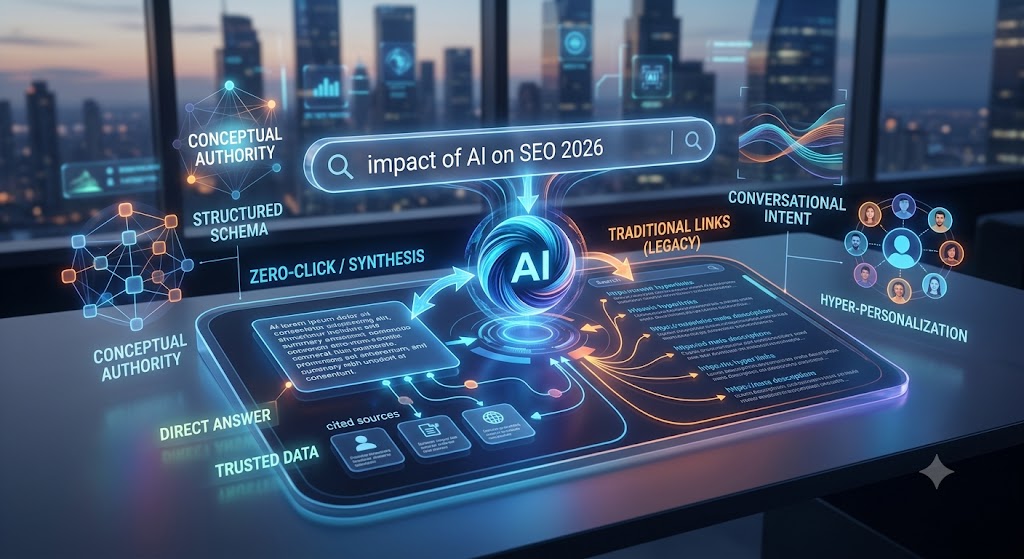
The landscape of Search Engine Optimization (SEO) has always been one of constant flux. But the shift that has unfolded leading into 2026 isn’t just an evolution; it’s a fundamental revolution, powered entirely by Artificial Intelligence. If your SEO strategy still mirrors what worked in 2023, you’re not just behind—you’re largely invisible.
For decades, the search engine was an index: a sophisticated librarian pointing you to the right shelf. Today, in 2026, AI search engines—spearheaded by the progeny of SGE (Search Generative Experience) and its competitors—have become the author. They no longer just direct; they synthesize, answer, and converse.
This article explores how this critical paradigm shift in AI-driven search has altered the core pillars of SEO.
The Demise of the “Blue Link” Era
The days of obsessing over getting the #1 blue link are fading. In 2026, the primary real estate on a search engine results page (SERP) is the AI-generated summary, often known as the “snapshot.” This synthesis of information, compiled instantly from across the web, answers the user’s query immediately.
For users, this is a massive leap in convenience. For SEO professionals, it’s a crisis of visibility. The “zero-click search”—where a user finds their answer without ever clicking through to a website—is now the dominant form of interaction for transactional and informational queries.
The Strategy Shift: SEO is no longer about maximizing clicks through to your page; it’s about becoming the trusted source that powers the AI’s answer. The goal is to get cited within the AI summary. This requires impeccable data structuring and authoritative, definitive content.
From Keywords to “Conceptual Authority”
AI models in 2026, powered by advanced Natural Language Processing (NLP), do not look for keywords. They understand concepts, intent, and context at a near-human level. They are looking for the absolute best, most comprehensive answer, not the page that mentions “best coffee maker” 15 times.
This has killed traditional keyword stuffing. Google’s algorithms now evaluate your “conceptual authority” on a topic.
The Strategy Shift: Instead of optimizing single pages for single keywords, you must build comprehensive “content pillars” that demonstrate deep, multifaceted expertise. Your content must answer not just the primary question, but the secondary and tertiary questions the AI predicts the user will ask next. Content must move beyond “E-E-A-T” (Experience, Expertise, Authoritativeness, and Trustworthiness) to being truly definitive.
Hyper-Personalization: One SERP, Many Faces
Search results are no longer static. In 2026, AI search is hyper-personalized to a degree previously unseen. Two users in the same room typing “best hiking boots” will receive different AI summaries and different source recommendations.
The AI analyzes the user’s past search history, real-time location, device usage, cross-platform behavior (e.g., what they watched on YouTube), and even their inferred purchase intent to tailor the response.
The Strategy Shift: “Broad SEO” is dead. You cannot optimize for everyone. Success in 2026 means knowing your ideal customer avatar intimately and tailoring content that specifically addresses their unique journey and pain points. Data—especially first-party data—is your most critical SEO asset.