
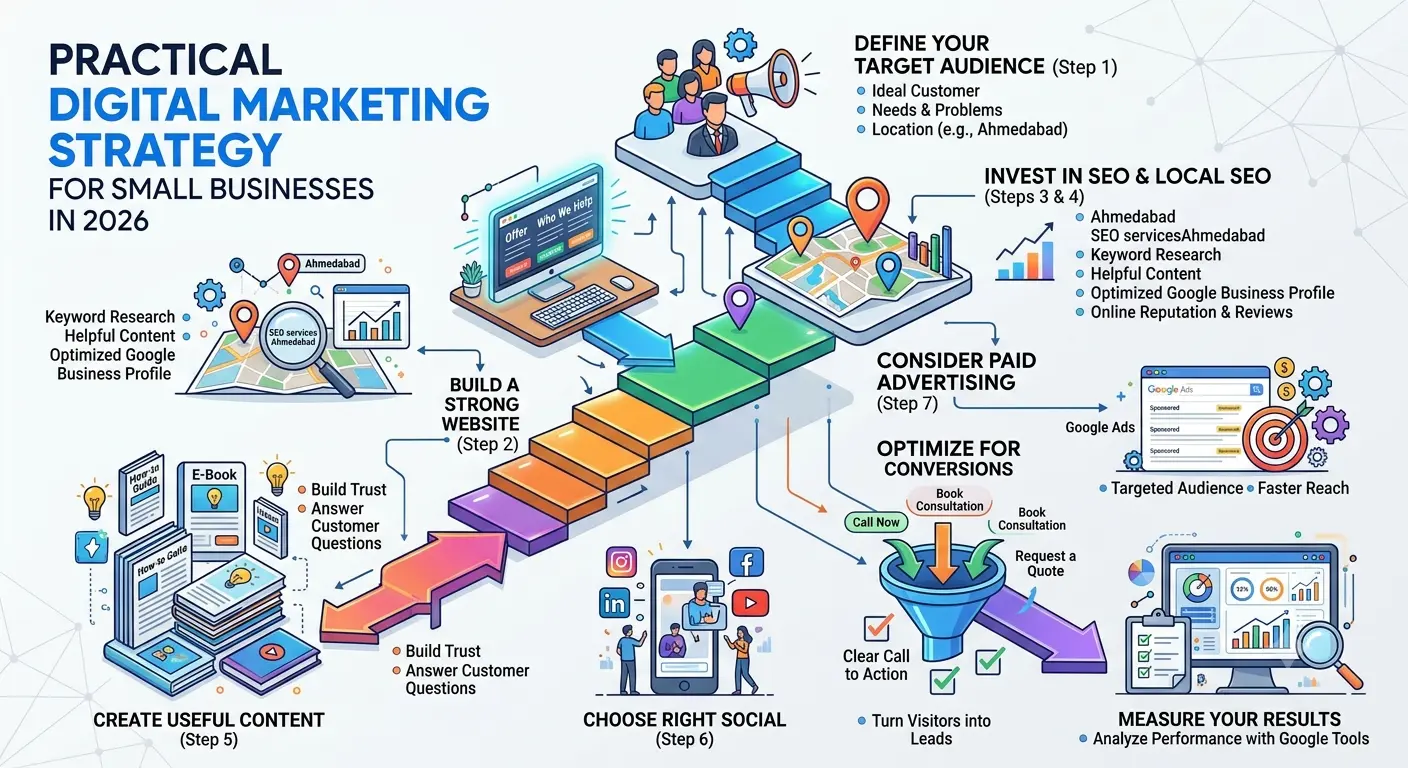
Digital marketing strategy for small businesses in 2026

Digital Marketing

Digital Marketing Strategy for Small Businesses in 2026


By Purvin Vyas


August 5, 2026

For a small business, having a good product or service is no longer enough. People usually search online before contacting a business, comparing options, reading reviews, visiting a website, or making a purchase.

That is why having a clear digital marketing strategy is important for small businesses in 2026.

The good news is that you do not need to use every digital marketing channel at once. A better approach is to understand your target audience, choose the right channels, create useful content, and consistently measure what is working.

In this guide, we will look at a practical digital marketing strategy that small businesses can use in 2026 to improve online visibility, attract the right audience, and generate more leads.

What Is a Digital Marketing Strategy?

A digital marketing strategy is a planned approach to promoting your business through online channels.

Depending on your business and target audience, this can include:

The goal is not simply to get more website visitors. A good strategy should help you attract the right people, build trust, and turn visitors into enquiries, leads, or customers.

Why Digital Marketing Is Important for Small Businesses in 2026

Consumers are increasingly using search engines, social media, maps, websites, reviews, and other online platforms to find businesses.

For a small business, digital marketing can provide several advantages.

1. Reach People Who Are Already Looking for Your Services

SEO and Local SEO can help your business appear when potential customers search for relevant products or services.

For example, someone searching for a service in Ahmedabad may already have a strong intention to contact a business.

Being visible at the right moment can be more valuable than simply reaching a large audience.

2. Build Trust Before the First Contact

Your website, Google Business Profile, reviews, social media presence, and content all contribute to your online reputation.

A potential customer may look at several businesses before making a decision.

A professional and informative online presence can help establish trust before the first phone call or enquiry.

3. Compete With Larger Businesses

Small businesses do not always need the biggest advertising budget.

A focused strategy can allow a small business to compete by targeting specific locations, services, audiences, and search queries.

This is particularly useful for local businesses that serve a specific city or area.

Build Your Digital Marketing Strategy Step by Step

Instead of trying everything at once, start with a clear foundation.

Step 1: Define Your Target Audience

Before choosing a marketing channel, understand who you want to reach.

Ask questions such as:

  • Who is your ideal customer?
  • What problem are they trying to solve?
  • What services are they looking for?
  • Where are they located?
  • What questions do they ask before buying?
  • What factors influence their decision?

The more clearly you understand your audience, the easier it becomes to create relevant content and choose the right marketing channels.

Step 2: Build a Strong Website

Your website is often the centre of your digital marketing strategy.

It should clearly explain:

  • What you offer
  • Who you help
  • Where you operate
  • Why customers should choose you
  • How customers can contact you

Your important service pages should also be easy to find through your website navigation and internal links.

A website should not only look professional. It should also provide a good user experience on mobile devices, load efficiently, and make it easy for visitors to take the next step.

Step 3: Invest in SEO

SEO can help your website appear in organic search results when people search for topics, services, or problems related to your business.

A basic SEO strategy can include:

  • Keyword research
  • Helpful website content
  • Optimized service pages
  • Technical SEO
  • Internal linking
  • Image optimization
  • Local SEO
  • Content marketing

The important thing is to focus on search intent rather than simply adding keywords to a page.

For example, a person searching for “SEO services Ahmedabad” may be looking for a service provider, while someone searching for “what is SEO” may simply be looking for information.

Your content should match what the searcher is actually looking for.

Step 4: Use Local SEO If You Serve a Specific Area

For businesses that serve a city or local area, Local SEO can be an important part of the strategy.

Make sure your business information is accurate and consistent across relevant online platforms.

Your Local SEO strategy can include:

  • Google Business Profile optimization
  • Accurate business information
  • Local keyword targeting
  • Customer reviews
  • Local citations
  • Location-focused website content
  • Relevant local links

For example, a business serving Ahmedabad may benefit from creating useful content and service pages relevant to customers searching for services in Ahmedabad.

Step 5: Create Useful Content

Content marketing helps you answer the questions your potential customers are already asking.

Instead of creating content only to promote your business, create content that helps people make better decisions.

You can publish:

  • How-to guides
  • Beginner’s guides
  • Industry insights
  • Frequently asked questions
  • Comparisons
  • Case studies
  • Problem-solving articles
  • Local business guides

For example, a digital marketing consultant could publish articles about SEO, Local SEO, website visibility, social media marketing, Google Business Profile, and online lead generation.

Over time, useful content can also create opportunities for internal linking to your relevant service pages.

Step 6: Choose the Right Social Media Platforms

You do not need to be active on every social media platform.

Choose platforms based on where your target audience spends time.

Depending on your business, this could include:

  • Instagram
  • Facebook
  • LinkedIn
  • YouTube
  • Other relevant platforms

Focus on consistent and useful content rather than simply posting every day.

You can share:

  • Educational tips
  • Short videos
  • Customer questions
  • Behind-the-scenes content
  • Industry updates
  • Helpful guides
  • Service-related information

Social media can help increase awareness and trust, while your website can provide more detailed information and conversion opportunities.

Step 7: Consider Paid Advertising

SEO and content marketing can take time to produce results. Paid advertising can help businesses reach potential customers more quickly.

Google Ads can be useful when people are actively searching for a product or service.

Social media advertising can also be useful when you want to reach a specific audience based on factors such as interests, location, or demographics.

However, paid advertising should be approached strategically.

Before spending money on ads, make sure you have:

  • A clear offer
  • A relevant landing page
  • A defined target audience
  • A clear call to action
  • A way to measure leads and conversions

Step 8: Optimize for Conversions

Getting visitors to your website is only part of digital marketing.

You also need to give visitors a clear next step.

Depending on your business, this could be:

  • Call now
  • Request a quote
  • Book a consultation
  • Send an enquiry
  • WhatsApp
  • Fill out a contact form
  • Buy a product

Make your call-to-action easy to understand and easy to find.

A simple and focused website can often perform better than one filled with unnecessary information.

Step 9: Measure Your Results

A digital marketing strategy should be measured regularly.

Useful metrics can include:

  • Website traffic
  • Search impressions
  • Organic clicks
  • Keyword performance
  • Leads
  • Conversion rate
  • Social media engagement
  • Advertising results

Tools such as Google Search Console and Google Analytics can help you understand how people are finding and using your website.

Do not judge your strategy only by traffic. The quality of the traffic and the number of relevant enquiries are often more important.

Digital Marketing Trends Small Businesses Should Watch in 2026

Digital marketing continues to change quickly, particularly with the growth of AI and changes in how people search for information.

Some important areas to watch include:

AI and Search

People are increasingly using AI-powered tools to discover information, compare options, and answer questions.

This makes it even more important for businesses to create clear, useful, trustworthy content.

Search Intent

Simply targeting a keyword is not enough.

Businesses should understand why someone is searching and create content that genuinely answers their needs.

Short-Form Video

Short-form video remains an important way to attract attention and explain products, services, and ideas quickly.

First-Party Data

Businesses should also think about building direct relationships with their audience through email lists, enquiries, customer relationships, and other channels they can manage directly.

A Simple Digital Marketing Strategy for a Small Business

If you are starting from scratch, you do not need a complicated plan.

A practical starting strategy could look like this:

Month 1

  • Improve the website
  • Define your target audience
  • Research keywords
  • Optimize important service pages
  • Set up analytics and Search Console

Month 2

  • Start publishing useful content
  • Improve Local SEO
  • Build internal links
  • Create consistent social media content

Month 3

  • Review search performance
  • Identify the content generating interest
  • Improve conversion opportunities
  • Consider paid advertising where appropriate

After that, continue measuring results and improving the strategy based on actual data.

Final Thoughts

A successful digital marketing strategy for small businesses in 2026 does not have to be complicated.

The most important thing is to build a strong foundation, understand your audience, choose the right channels, create useful content, and measure your results consistently.

For many small businesses, a combination of SEO, Local SEO, content marketing, social media, and carefully planned paid advertising can create a strong online presence.

The key is consistency. Digital marketing is not a one-time activity. It is an ongoing process of testing, learning, improving, and adapting to how your customers search and make decisions online.

For a small business, having a good product or service is no longer enough. People usually search online before contacting a business, comparing options, reading reviews, visiting a website, or making a purchase.

That is why having a clear digital marketing strategy is important for small businesses in 2026.

The good news is that you do not need to use every digital marketing channel at once. A better approach is to understand your target audience, choose the right channels, create useful content, and consistently measure what is working.

In this guide, we will look at a practical digital marketing strategy that small businesses can use in 2026 to improve online visibility, attract the right audience, and generate more leads.

What Is a Digital Marketing Strategy?

A digital marketing strategy is a planned approach to promoting your business through online channels.

Depending on your business and target audience, this can include:

The goal is not simply to get more website visitors. A good strategy should help you attract the right people, build trust, and turn visitors into enquiries, leads, or customers.

Why Digital Marketing Is Important for Small Businesses in 2026

Consumers are increasingly using search engines, social media, maps, websites, reviews, and other online platforms to find businesses.

For a small business, digital marketing can provide several advantages.

1. Reach People Who Are Already Looking for Your Services

SEO and Local SEO can help your business appear when potential customers search for relevant products or services.

For example, someone searching for a service in Ahmedabad may already have a strong intention to contact a business.

Being visible at the right moment can be more valuable than simply reaching a large audience.

2. Build Trust Before the First Contact

Your website, Google Business Profile, reviews, social media presence, and content all contribute to your online reputation.

A potential customer may look at several businesses before making a decision.

A professional and informative online presence can help establish trust before the first phone call or enquiry.

3. Compete With Larger Businesses

Small businesses do not always need the biggest advertising budget.

A focused strategy can allow a small business to compete by targeting specific locations, services, audiences, and search queries.

This is particularly useful for local businesses that serve a specific city or area.

Build Your Digital Marketing Strategy Step by Step

Instead of trying everything at once, start with a clear foundation.

Step 1: Define Your Target Audience

Before choosing a marketing channel, understand who you want to reach.

Ask questions such as:

  • Who is your ideal customer?
  • What problem are they trying to solve?
  • What services are they looking for?
  • Where are they located?
  • What questions do they ask before buying?
  • What factors influence their decision?

The more clearly you understand your audience, the easier it becomes to create relevant content and choose the right marketing channels.

Step 2: Build a Strong Website

Your website is often the centre of your digital marketing strategy.

It should clearly explain:

  • What you offer
  • Who you help
  • Where you operate
  • Why customers should choose you
  • How customers can contact you

Your important service pages should also be easy to find through your website navigation and internal links.

A website should not only look professional. It should also provide a good user experience on mobile devices, load efficiently, and make it easy for visitors to take the next step.

Step 3: Invest in SEO

SEO can help your website appear in organic search results when people search for topics, services, or problems related to your business.

A basic SEO strategy can include:

  • Keyword research
  • Helpful website content
  • Optimized service pages
  • Technical SEO
  • Internal linking
  • Image optimization
  • Local SEO
  • Content marketing

The important thing is to focus on search intent rather than simply adding keywords to a page.

For example, a person searching for “SEO services Ahmedabad” may be looking for a service provider, while someone searching for “what is SEO” may simply be looking for information.

Your content should match what the searcher is actually looking for.

Step 4: Use Local SEO If You Serve a Specific Area

For businesses that serve a city or local area, Local SEO can be an important part of the strategy.

Make sure your business information is accurate and consistent across relevant online platforms.

Your Local SEO strategy can include:

  • Google Business Profile optimization
  • Accurate business information
  • Local keyword targeting
  • Customer reviews
  • Local citations
  • Location-focused website content
  • Relevant local links

For example, a business serving Ahmedabad may benefit from creating useful content and service pages relevant to customers searching for services in Ahmedabad.

Step 5: Create Useful Content

Content marketing helps you answer the questions your potential customers are already asking.

Instead of creating content only to promote your business, create content that helps people make better decisions.

You can publish:

  • How-to guides
  • Beginner’s guides
  • Industry insights
  • Frequently asked questions
  • Comparisons
  • Case studies
  • Problem-solving articles
  • Local business guides

For example, a digital marketing consultant could publish articles about SEO, Local SEO, website visibility, social media marketing, Google Business Profile, and online lead generation.

Over time, useful content can also create opportunities for internal linking to your relevant service pages.

Step 6: Choose the Right Social Media Platforms

You do not need to be active on every social media platform.

Choose platforms based on where your target audience spends time.

Depending on your business, this could include:

  • Instagram
  • Facebook
  • LinkedIn
  • YouTube
  • Other relevant platforms

Focus on consistent and useful content rather than simply posting every day.

You can share:

  • Educational tips
  • Short videos
  • Customer questions
  • Behind-the-scenes content
  • Industry updates
  • Helpful guides
  • Service-related information

Social media can help increase awareness and trust, while your website can provide more detailed information and conversion opportunities.

Step 7: Consider Paid Advertising

SEO and content marketing can take time to produce results. Paid advertising can help businesses reach potential customers more quickly.

Google Ads can be useful when people are actively searching for a product or service.

Social media advertising can also be useful when you want to reach a specific audience based on factors such as interests, location, or demographics.

However, paid advertising should be approached strategically.

Before spending money on ads, make sure you have:

  • A clear offer
  • A relevant landing page
  • A defined target audience
  • A clear call to action
  • A way to measure leads and conversions

Step 8: Optimize for Conversions

Getting visitors to your website is only part of digital marketing.

You also need to give visitors a clear next step.

Depending on your business, this could be:

  • Call now
  • Request a quote
  • Book a consultation
  • Send an enquiry
  • WhatsApp
  • Fill out a contact form
  • Buy a product

Make your call-to-action easy to understand and easy to find.

A simple and focused website can often perform better than one filled with unnecessary information.

Step 9: Measure Your Results

A digital marketing strategy should be measured regularly.

Useful metrics can include:

  • Website traffic
  • Search impressions
  • Organic clicks
  • Keyword performance
  • Leads
  • Conversion rate
  • Social media engagement
  • Advertising results

Tools such as Google Search Console and Google Analytics can help you understand how people are finding and using your website.

Do not judge your strategy only by traffic. The quality of the traffic and the number of relevant enquiries are often more important.

Digital Marketing Trends Small Businesses Should Watch in 2026

Digital marketing continues to change quickly, particularly with the growth of AI and changes in how people search for information.

Some important areas to watch include:

AI and Search

People are increasingly using AI-powered tools to discover information, compare options, and answer questions.

This makes it even more important for businesses to create clear, useful, trustworthy content.

Search Intent

Simply targeting a keyword is not enough.

Businesses should understand why someone is searching and create content that genuinely answers their needs.

Short-Form Video

Short-form video remains an important way to attract attention and explain products, services, and ideas quickly.

First-Party Data

Businesses should also think about building direct relationships with their audience through email lists, enquiries, customer relationships, and other channels they can manage directly.

A Simple Digital Marketing Strategy for a Small Business

If you are starting from scratch, you do not need a complicated plan.

A practical starting strategy could look like this:

Month 1

  • Improve the website
  • Define your target audience
  • Research keywords
  • Optimize important service pages
  • Set up analytics and Search Console

Month 2

  • Start publishing useful content
  • Improve Local SEO
  • Build internal links
  • Create consistent social media content

Month 3

  • Review search performance
  • Identify the content generating interest
  • Improve conversion opportunities
  • Consider paid advertising where appropriate

After that, continue measuring results and improving the strategy based on actual data.

Final Thoughts

A successful digital marketing strategy for small businesses in 2026 does not have to be complicated.

The most important thing is to build a strong foundation, understand your audience, choose the right channels, create useful content, and measure your results consistently.

For many small businesses, a combination of SEO, Local SEO, content marketing, social media, and carefully planned paid advertising can create a strong online presence.

The key is consistency. Digital marketing is not a one-time activity. It is an ongoing process of testing, learning, improving, and adapting to how your customers search and make decisions online.

Let's Grow Your Business 🚀

Share your project details and we'll get back to you within 24 hours.

Sample SEO Audit Report

Here is a sample SEO audit report to give you an idea of what we analyze.