

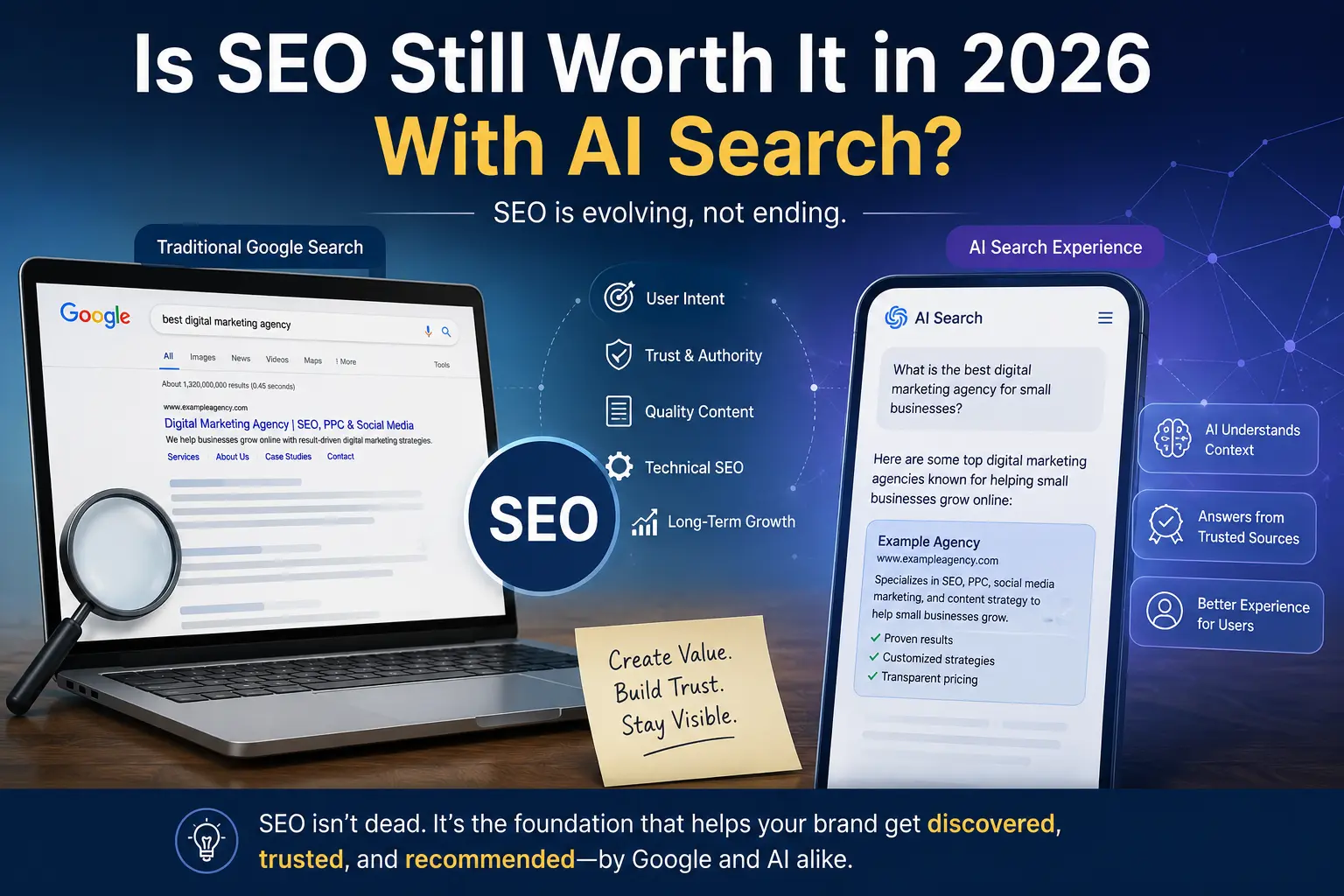
If you work in digital marketing today, one question comes up again and again:
“With AI giving people direct answers, is SEO still worth it in 2026?”
My short answer is yes—but SEO is no longer the same game it was a few years ago.
After working with websites and SEO, I have seen how search behaviour has changed. Earlier, the main objective was to rank a website on Google, preferably on the first page. Today, people may search on Google, ask ChatGPT, use AI Overviews, or look for an answer directly inside an AI-powered search experience.
So, naturally, businesses are asking whether traditional SEO still makes sense.
Does AI Search Replace Google Search?
Not really.
AI search has changed how people discover information, but it has not removed the need for websites, content, authority or search visibility.
When someone asks an AI tool a question, the answer still needs reliable information behind it. AI systems need to understand websites, topics, businesses, products and experts.
This is where SEO continues to have an important role.
The difference is that earlier we mainly focused on “How do I rank my page?”
Now we also need to think:
“How do I make my business or content useful enough to be found, understood and trusted by both search engines and AI systems?”
Is Keyword Ranking Still Important in 2026?
Yes, but rankings alone should not be the final goal.
A website can rank for a keyword and still receive very little business if the content does not answer the user’s actual question.
Modern SEO needs a stronger focus on search intent.
For example, if someone searches for “SEO services in Ahmedabad,” they may not simply want an article explaining SEO. They may be looking for an agency or freelancer, checking services, comparing prices, or trying to understand whether SEO can help their business.
Good SEO understands this difference.
What Has Changed With AI Search?
The biggest change I see is the importance of useful, clear and trustworthy content.
AI can produce thousands of articles within minutes. Because of that, simply publishing more content is no longer a strong SEO strategy.
Businesses need content that demonstrates experience, answers real customer questions and provides something useful that generic AI-generated content cannot easily provide.
Technical SEO is still important. Website speed, mobile usability, indexing, internal linking, structured content and clean website architecture continue to matter.
But these technical elements now work together with content quality, topical authority, brand reputation and user experience.
Should Businesses Stop Investing in SEO?
I would not recommend that.
In fact, I believe businesses should look at SEO as a long-term visibility strategy, rather than only a Google ranking exercise.
A strong SEO foundation can help a business appear in traditional search results, local search, featured results and potentially AI-generated answers.
However, expectations need to be realistic. SEO is not an overnight marketing method. Depending on the competition, website condition and industry, meaningful results can take time.
So, Is SEO Still Worth It in 2026?
Yes—but the definition of SEO has expanded.
SEO in 2026 is not just about keywords, backlinks and Google rankings. It is about making a website technically sound, creating genuinely useful content, understanding what people are asking, building authority and making a business easy to understand across modern search platforms.
AI has not killed SEO.
It has raised the standard for good SEO.
The businesses that continue to focus on real expertise, useful information, strong websites and genuine customer value are the ones I believe will remain visible—whether the user finds them through Google today or an AI-powered search experience tomorrow.