
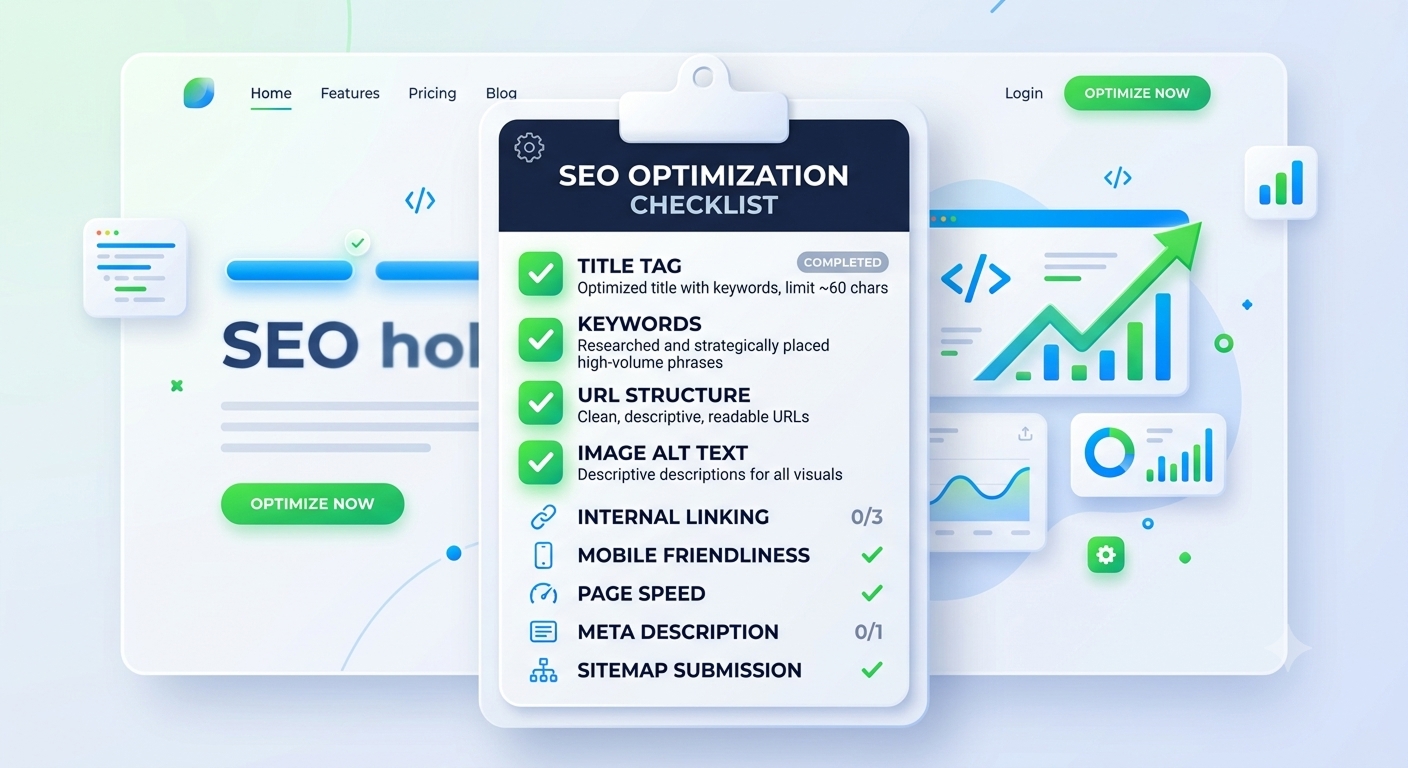
SEO

On-Page SEO Checklist: How to Optimize Your Content for Higher Rankings


By Purvin Vyas


July 18, 2026

Imagine you’ve written an incredible, deeply researched article. It’s got great insights, but when you look at Google, your page is nowhere to be found. Why? Because while humans might appreciate your writing, search engines haven’t been given the right structural clues to understand what your page is actually about.

This is where On-Page SEO comes in.

On-page SEO is the practice of optimizing individual web pages to rank higher and earn more relevant traffic. While Off-Page SEO relies on external factors like building backlinks, On-Page SEO is entirely under your control.

Let’s dive into the ultimate on-page checklist you need to follow every time you hit “Publish.”

1 Master the “Big Three” HTML Tags

Search engine crawlers and AI search systems scan specific parts of your code first to figure out the topic of your page. You must place your target keyword naturally in these three spots:

  • Title Tag (SEO Title): This is the headline that appears in Google search results. Keep it under 60 characters so it doesn’t get cut off, and try to place your primary keyword near the beginning.
  • The H1 Heading: This is the title your readers see on the actual page. You should only use one H1 tag per page to avoid confusing search bots.
  • Meta Description: This is the short summary snippet underneath your title link in search results. While it isn’t a direct ranking factor, a compelling description under 160 characters acts like an ad, convincing users to click on your link instead of a competitor’s.

2 Structure Content with a Logical Hierarchy

Nobody wants to read a massive wall of text. Breaking up your content into chunks using subheadings (H2, H3, H4) makes it highly scannable for humans and clear for algorithms.

Pro Tip: Never skip heading levels. An H2 subheading should be followed by an H3, not an H4. Use your primary and secondary keywords naturally inside these subheadings.

Keep URLs Short and Clean

Your page’s URL address should be clean, readable, and keyword-focused.

  • Bad URL: [mysite.com/blog/2026/page-id-98342?ref=share](https://mysite.com/blog/2026/page-id-98342?ref=share)
  • Good URL: [mysite.com/on-page-seo-checklist](https://mysite.com/on-page-seo-checklist)

Always use hyphens ( dashes ) instead of spaces or underscores to separate words.

Don’t Forget Image Optimization

Google Images drives a massive amount of traffic, yet image optimization is often completely ignored.

  • Use descriptive file names: Rename IMG_0432.png to something like on-page-seo-checklist.png before uploading.
  • Write Alt Text: Alt text (alternative text) tells search engines and screen-readers exactly what is in the image. Include your keyword here, but only if it accurately describes the graphic.
  • Compress files: Large images slow down your page speed. Convert your images to modern formats like WebP to keep your site fast.

Build a Smart Web of Internal Links

Internal linking means linking from one page on your website to another relevant page on your site. This helps search engine crawlers discover new content faster and passes “ranking power” across your domain.

When adding a link, use descriptive anchor text (the clickable text). Instead of writing “To see our checklist, click here,” write “Follow our comprehensive [on-page SEO checklist] to optimize your site.”

Summary Checklist

On-Page Element Quick Best Practice
Title Tag Under 60 characters, keyword front-loaded.
H1 Tag Exactly one per page, matches search intent.
Meta Description 120-160 characters, includes a call-to-action.
URL Slug Short, hyphen-separated, contains primary keyword.
Images Labeled with descriptive Alt Text, compressed to WebP.
Internal Links 2 to 5 links per post using natural anchor text.

By spending just 10-15 minutes checking off these on-page optimization steps before publishing, you give your content the absolute best chance to rise to the top of the search engine results pages (SERPs).

Imagine you’ve written an incredible, deeply researched article. It’s got great insights, but when you look at Google, your page is nowhere to be found. Why? Because while humans might appreciate your writing, search engines haven’t been given the right structural clues to understand what your page is actually about.

This is where On-Page SEO comes in.

On-page SEO is the practice of optimizing individual web pages to rank higher and earn more relevant traffic. While Off-Page SEO relies on external factors like building backlinks, On-Page SEO is entirely under your control.

Let’s dive into the ultimate on-page checklist you need to follow every time you hit “Publish.”

1 Master the “Big Three” HTML Tags

Search engine crawlers and AI search systems scan specific parts of your code first to figure out the topic of your page. You must place your target keyword naturally in these three spots:

  • Title Tag (SEO Title): This is the headline that appears in Google search results. Keep it under 60 characters so it doesn’t get cut off, and try to place your primary keyword near the beginning.
  • The H1 Heading: This is the title your readers see on the actual page. You should only use one H1 tag per page to avoid confusing search bots.
  • Meta Description: This is the short summary snippet underneath your title link in search results. While it isn’t a direct ranking factor, a compelling description under 160 characters acts like an ad, convincing users to click on your link instead of a competitor’s.

2 Structure Content with a Logical Hierarchy

Nobody wants to read a massive wall of text. Breaking up your content into chunks using subheadings (H2, H3, H4) makes it highly scannable for humans and clear for algorithms.

Pro Tip: Never skip heading levels. An H2 subheading should be followed by an H3, not an H4. Use your primary and secondary keywords naturally inside these subheadings.

Keep URLs Short and Clean

Your page’s URL address should be clean, readable, and keyword-focused.

  • Bad URL: [mysite.com/blog/2026/page-id-98342?ref=share](https://mysite.com/blog/2026/page-id-98342?ref=share)
  • Good URL: [mysite.com/on-page-seo-checklist](https://mysite.com/on-page-seo-checklist)

Always use hyphens ( dashes ) instead of spaces or underscores to separate words.

Don’t Forget Image Optimization

Google Images drives a massive amount of traffic, yet image optimization is often completely ignored.

  • Use descriptive file names: Rename IMG_0432.png to something like on-page-seo-checklist.png before uploading.
  • Write Alt Text: Alt text (alternative text) tells search engines and screen-readers exactly what is in the image. Include your keyword here, but only if it accurately describes the graphic.
  • Compress files: Large images slow down your page speed. Convert your images to modern formats like WebP to keep your site fast.

Build a Smart Web of Internal Links

Internal linking means linking from one page on your website to another relevant page on your site. This helps search engine crawlers discover new content faster and passes “ranking power” across your domain.

When adding a link, use descriptive anchor text (the clickable text). Instead of writing “To see our checklist, click here,” write “Follow our comprehensive [on-page SEO checklist] to optimize your site.”

Summary Checklist

On-Page ElementQuick Best Practice
Title TagUnder 60 characters, keyword front-loaded.
H1 TagExactly one per page, matches search intent.
Meta Description120-160 characters, includes a call-to-action.
URL SlugShort, hyphen-separated, contains primary keyword.
ImagesLabeled with descriptive Alt Text, compressed to WebP.
Internal Links2 to 5 links per post using natural anchor text.

By spending just 10-15 minutes checking off these on-page optimization steps before publishing, you give your content the absolute best chance to rise to the top of the search engine results pages (SERPs).

Let's Grow Your Business 🚀

Share your project details and we'll get back to you within 24 hours.

Sample SEO Audit Report

Here is a sample SEO audit report to give you an idea of what we analyze.