

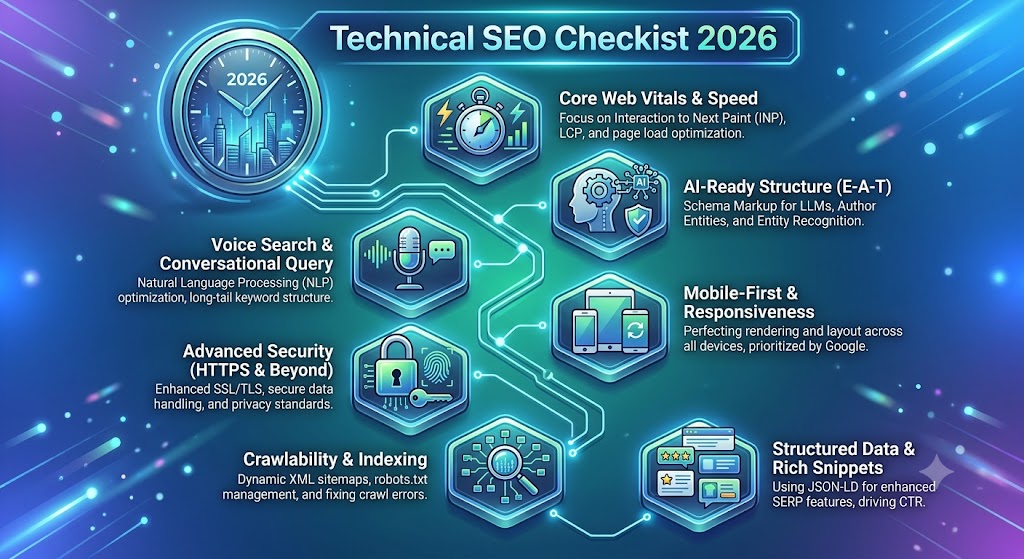
As we move toward 2026, the landscape of Technical SEO continues to evolve at breakneck speed. What worked in 2023 is no longer sufficient; the modern search landscape is defined by deeper AI integration, hyper-fast performance expectations, and conversational interfaces. To ensure your website remains visible and competitive, a rigid adherence to an updated technical foundation is non-negotiable.
Here is your essential Technical SEO checklist to future-proof your digital presence for 2026.
Master the Evolution of Core Web Vitals
By 2026, standard “fast loading” is the baseline, not a differentiator. The focus has shifted definitively from simple metrics like Largest Contentful Paint (LCP) to highly granular interaction data.
- Prioritize Interaction to Next Paint (INP): INP is now the primary metric for measuring responsiveness. Your site must respond instantly to user inputs (clicks, taps, keyboard presses). Optimization requires minimizing main-thread JavaScript blocking.
- Achieve Sub-Second Rendering: While LCP matters, aim for sub-second rendering for critical above-the-fold content. Leverage advanced prioritization, asset compression (like AVIF/WebP), and HTTP/3 to stream data faster.
Build for AI-Ready Infrastructure (Schema & Entities)
Search engines are no longer just indexing text; they are building knowledge graphs. In 2026, AI-driven search experiences (like SGE/AI Overviews) rely heavily on understanding context and relationships.
- Implement Advanced Schema Markup (JSON-LD): Move beyond basic product schema. Implement complex schema that defines relationships, including
Speakable(for voice),Author,Organization, andDataset. The goal is to provide explicit context to Large Language Models (LLMs). - Focus on Entity Recognition: Technical SEO must support E-A-T (Expertise, Authoritativeness, Trustworthiness). Ensure your site architecture clearly defines author entities and references credible external nodes in the knowledge graph.
Native Optimization for Voice and Conversational Queries
The “search bar” is increasingly replaced by conversational interfaces (think smart speakers, chatbots, and mobile assistants).
- Long-Tail and Natural Language Structures: Your technical hierarchy, specifically H1s, H2s, and FAQ structures, must align with how people speak questions, not just how they type keywords.
- Structure Data for Rich Snippets: While always important, by 2026, optimizing for rich snippets and conversational answers is the key to capturing “position zero” in voice results.